You have studied French for years and can hold a conversation, write an essay and understand unfamiliar texts. But the IB French B HL individual oral introduces a different challenge: discussing a literary extract in French with only 20 minutes of preparation.
How much literary analysis is expected? Do you need to memorise quotations? What happens if your teacher asks a question you cannot immediately answer?
These concerns appeared in a June 2026 r/IBO discussion, where a student considering French B HL after GCSE asked whether the course involved literary analysis or primarily tested language proficiency.
The distinction matters.
French B HL students must understand and discuss literature, but the individual oral is fundamentally an assessment of spoken communication, not a Language A literary criticism examination.
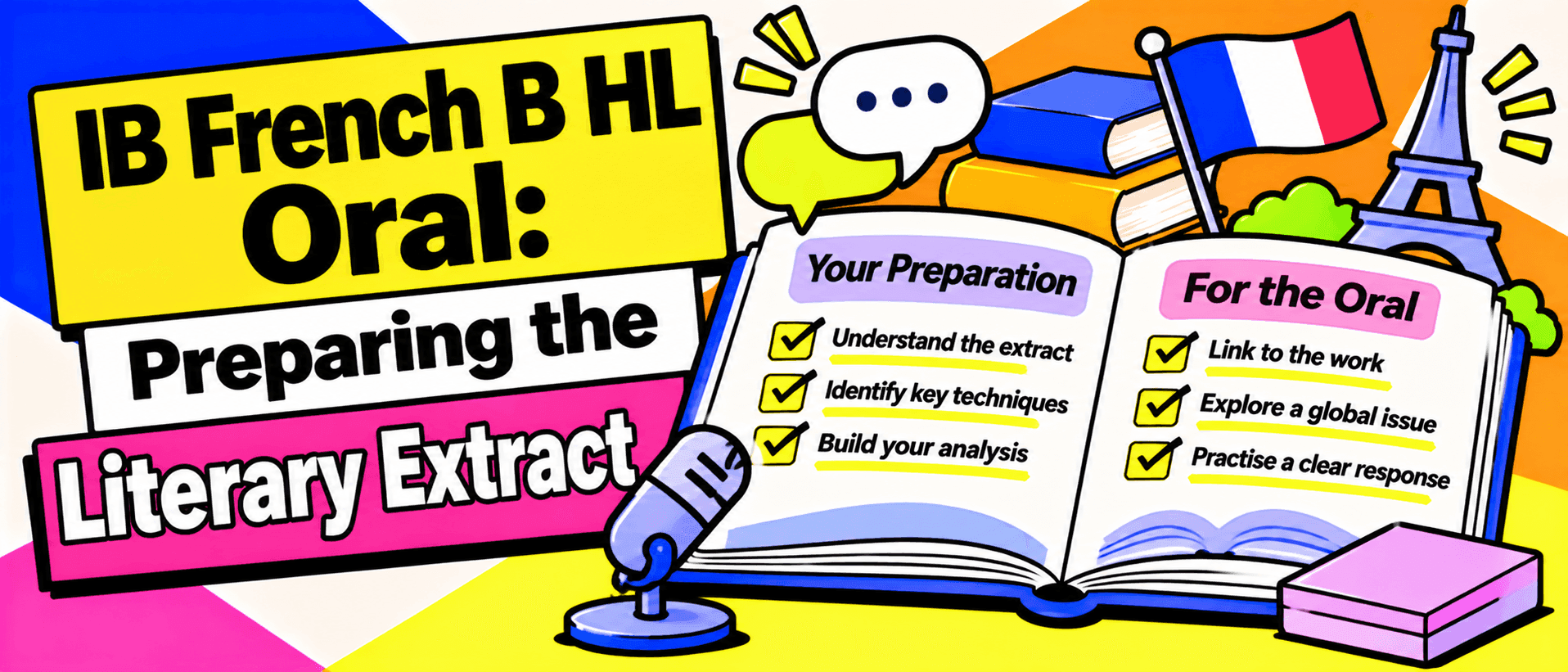
This guide explains the official format, assessment criteria, practical preparation strategies and how to discuss characters, events and ideas using an original French practice extract.
What Is the IB French B HL Individual Oral?
According to the official IB Language B curriculum, Higher Level students study two literary works originally written in the target language.
These works provide the basis for the HL individual oral assessment.
The assessment takes place during the final year of the course and is conducted by the student's teacher.
It assesses the ability to communicate effectively in French through a prepared presentation and spontaneous conversation.
| Assessment detail | French B HL |
|---|---|
| Assessment component | Individual oral |
| Final grade weighting | 25% |
| Oral duration | 12 to 15 minutes |
| Supervised preparation | 20 minutes |
| Stimulus | Literary extract |
| Extract length | Up to approximately 300 words |
| Literary works studied | Two original French-language works |
| Maximum marks | 30 |
These requirements come from the Language B guide for first assessment in 2020, which remains applicable to the current examination sessions.
The IB has also published information about a revised Language B course for first assessment in 2029. Students should use the guide applicable to their own examination year.
French B SL vs HL: What Changes in the Oral?
Both Standard Level and Higher Level students complete an individual oral lasting 12 to 15 minutes.
However, the stimulus and preparation requirements differ.
| Feature | French B SL | French B HL |
|---|---|---|
| Stimulus | Visual image | Literary extract |
| Preparation time | 15 minutes | 20 minutes |
| Choice provided | Two visual stimuli | Two literary extracts |
| Presentation | Describe image and connect to the relevant theme and target culture | Discuss events, characters, ideas and messages in the extract |
| Follow-up | Discussion related to visual stimulus | Discussion related to literary extract |
| Final conversation | Broader course themes | Broader course themes |
At HL, students choose between two extracts, one from each literary work studied during the course.
The teacher selects the specific passages, and students do not know in advance which extracts will appear.
This makes understanding the works as a whole more useful than memorising presentations about selected chapters.
The Three Parts of the French B HL Oral
The 2027 IB examiner instructions confirm the following structure.
| Part | Duration | What you do |
|---|---|---|
| Part 1: Presentation | 3 to 4 minutes | Present and interpret the literary extract |
| Part 2: Follow-up discussion | 4 to 5 minutes | Respond to questions about the extract |
| Part 3: General discussion | 5 to 6 minutes | Discuss one or more of the five prescribed course themes |
The timings are approximate, but the complete oral must not exceed 15 minutes.
The final discussion is not necessarily connected to the literary extract.
You might begin by discussing a character's experience of belonging and later be asked about technology, social relationships or environmental responsibility.
Preparation must therefore cover both literature and broader conversational fluency.
Is Literary Analysis Actually Required?
This is one of the most misunderstood aspects of French B HL.
The 2027 examiner guidance explicitly states that formal literary analysis or criticism is not expected in Language B HL.
Students do not need to deliver the kind of detailed stylistic commentary required in Language A.
Instead, they should demonstrate understanding of the extract's characters, events, ideas and themes.
For example, rather than identifying every metaphor, explain what a character's decision reveals about their feelings or relationships.
You can discuss literary features when they help communicate an idea, but complex terminology is not essential.
The same guidance warns against presentations that become general book reviews.
The majority of your presentation must remain focused on the specific passage you receive.
How to Use Your 20 Minutes of Preparation
During preparation, you cannot consult dictionaries, class notes, digital devices or copies of the complete literary works.
You may annotate the selected extract and prepare up to ten brief bullet-point notes.
A practical time allocation is:
| Preparation activity | Suggested time |
|---|---|
| Read both extracts and choose one | 2 minutes |
| Read the chosen extract carefully | 5 minutes |
| Identify characters, events and central ideas | 4 minutes |
| Create a short presentation plan | 5 minutes |
| Mentally practise transitions and check notes | 4 minutes |
| Total | 20 minutes |
These are suggested practice timings, not official IB allocations.
Do not try to write a complete script.
Your notes should remind you of the argument and sequence, not contain sentences you intend to read aloud.
Original French Practice Extract
The following passage is an original fictional text created for oral preparation.
It is not taken from an IB literary work and would not itself qualify as an official HL oral stimulus. In the actual assessment, the extract must come from one of the two literary works studied in class.
La dernière librairie
Le samedi matin, Camille avait promis à sa mère de l'aider à fermer la librairie du quartier. Depuis l'annonce de sa fermeture, chaque visite ressemblait à un adieu.
Devant la vitrine, Camille aperçut Nadir, un ancien camarade de classe. Il photographiait l'affiche « À louer ».
« Tu vas publier ça ? » demanda-t-elle.
« Oui. Beaucoup de gens ignorent ce qui se passe ici. »
Camille haussa les épaules. « Ils préfèrent commander leurs livres en ligne. Une photo ne changera rien. »
Nadir resta silencieux, puis désigna un petit banc près de la fenêtre.
« Tu te souviens quand ta mère nous lisait des histoires ici ? »
Camille regarda le banc. Elle n'avait pas pensé à ces après-midi depuis longtemps. Elle remarqua les dessins d'enfants encore collés au mur.
« Peut-être qu'on pourrait organiser une lecture publique », proposa Nadir.
« Et si personne ne venait ? »
« Alors, on aura au moins essayé. »
Camille ouvrit la porte. Pour la première fois depuis plusieurs semaines, elle ne pensa pas seulement à ce que le quartier allait perdre, mais à ce qu'il pouvait encore sauver.
Step 1: Identify What Happens in the Extract
Begin by establishing the situation.
Who are the characters? Where are they? What changes during the passage?
In this example, Camille is preparing for the closure of her mother's neighbourhood bookshop.
Nadir proposes public action, while Camille initially doubts that anything can change.
Their conversation encourages Camille to reconsider her attitude.
A concise French summary could be:
Dans cet extrait, Camille et Nadir discutent de la fermeture d'une librairie. Au début, Camille semble pessimiste, mais les souvenirs de son enfance et la proposition de Nadir lui redonnent progressivement de l'espoir.
This is stronger than narrating every sentence in order because it identifies the central development.
Step 2: Discuss Characters and Their Perspectives
The characters represent contrasting responses to the same problem.
Camille is initially discouraged.
Nadir believes that collective action may still have value.
An effective explanation should connect these attitudes to moments in the extract.
For example:
Camille paraît résignée parce qu'elle pense qu'une simple photo ne changera rien. En revanche, Nadir est plus optimiste. Il propose une action concrète pour mobiliser les habitants du quartier.
The response explains the contrast and refers to evidence.
It does not require elaborate literary terminology.
Students can develop their personal interpretation using expressions such as:
À mon avis...
Il me semble que...
Ce passage montre que...
On peut comprendre la réaction du personnage parce que...
These phrases support interpretation while keeping the language natural.
Step 3: Identify the Important Ideas
The fictional extract raises several ideas.
Community identity: The bookshop represents more than a place where products are sold.
Change: Online shopping has influenced the future of a local business.
Collective action: Nadir suggests that residents can respond to a shared problem.
Memory and belonging: Camille's childhood experiences influence her understanding of the bookshop's importance.
Rather than listing these ideas, explain how they connect.
For example:
La librairie représente un lieu de rencontre et de partage. Sa fermeture menace donc non seulement un commerce, mais aussi une partie de l'identité du quartier.
This develops an interpretation based on the extract.
It could also provide a bridge to a wider discussion of community life, although the main presentation should remain focused on the literary passage.
Step 4: Organise a Three-to-Four-Minute Presentation
A useful structure is:
| Stage | Suggested time | Purpose |
|---|---|---|
| Brief introduction | 20 to 30 seconds | Identify the extract and situation |
| Main events | 45 seconds | Explain what happens |
| Characters and ideas | 90 seconds | Develop observations with evidence |
| Interpretation and brief context | 45 to 60 seconds | Explain significance and relate briefly to the work |
| Closing observation | 15 seconds | Summarise the central message |
This framework is flexible, not an official prescribed structure.
An opening might be:
Dans cet extrait, nous découvrons un moment important pour Camille, qui doit accepter la fermeture de la librairie familiale. La conversation avec Nadir l'amène à réfléchir au rôle de ce lieu dans la communauté.
Then develop two or three important observations.
Avoid spending two minutes describing the entire novel before discussing the selected passage.
Step 5: Prepare for the Follow-Up Discussion
Part 2 is an interactive conversation about the extract.
The teacher may ask you to explain your interpretation, clarify a character's motivation or consider a different perspective.
For the fictional bookshop extract, possible original practice questions include:
- Pourquoi Camille est-elle pessimiste au début du passage ?
- Quel rôle jouent les souvenirs dans l'évolution de Camille ?
- Pensez-vous que la proposition de Nadir soit réaliste ?
- Pourquoi les lieux culturels sont-ils importants pour une communauté ?
A useful answer should go beyond one sentence.
For example:
Je pense que la proposition de Nadir est intéressante parce qu'elle encourage les habitants à agir ensemble. Cependant, une lecture publique ne suffira peut-être pas à résoudre les difficultés financières de la librairie. Il faudrait aussi réfléchir à d'autres solutions.
The response gives an opinion, justifies it and introduces a limitation.
This helps sustain a meaningful conversation.
Step 6: Prepare for the General Discussion
Part 3 moves beyond the extract to the prescribed Language B themes.
These are:
| Course theme | Possible French practice question |
|---|---|
| Identities | Comment notre communauté influence-t-elle notre identité ? |
| Experiences | Quelle expérience personnelle vous a fait changer d'avis ? |
| Human ingenuity | Comment la technologie transforme-t-elle notre vie quotidienne ? |
| Social organization | Quel rôle les associations jouent-elles dans votre société ? |
| Sharing the planet | Quelles actions individuelles peuvent protéger l'environnement ? |
Practise discussing all five themes.
Do not prepare only the theme that appears most relevant to your literary works.
The teacher may move to another topic, and the assessment measures your ability to respond appropriately to a developing conversation.
Understand the Four Oral Assessment Criteria
The French B HL oral is marked out of 30.
| Criterion | Marks | Main assessment focus |
|---|---|---|
| A: Language | 12 | Vocabulary, grammar, pronunciation and intonation |
| B1: Message, literary extract | 6 | Relevance and development of ideas in the presentation |
| B2: Message, conversation | 6 | Appropriate and developed responses to questions |
| C: Interactive skills | 6 | Understanding, responding and sustaining communication |
| Total | 30 |
The official Language B guide establishes these four criteria.
Criterion A is worth 40% of the oral marks.
This reinforces the importance of clear spoken French.
Meanwhile, B1 requires observations supported by the extract, and B2 and C reward meaningful participation in conversation.
You do not need flawless pronunciation, but errors should not consistently interfere with communication.
What If You Don't Understand a Question?
Spontaneous conversation can be difficult, even for confident speakers.
If necessary, politely ask the teacher to repeat or clarify a question.
Useful French expressions include:
Pourriez-vous répéter la question, s'il vous plaît ?
Si j'ai bien compris, vous me demandez si...
C'est une question intéressante. Je dirais que...
Je n'avais pas envisagé cette possibilité, mais...
The 2027 examiner instructions clarify that occasional requests for repetition should not automatically reduce the mark.
However, repeated difficulty understanding questions may affect the assessment of interaction.
Practise responding thoughtfully rather than memorising complete answers to predictable questions.
Common Mistakes in the French B HL Oral
Several approaches can weaken an otherwise promising performance.
Retelling the entire novel: Keep background context brief and prioritise the selected passage.
Using complicated literary terminology unnecessarily: Explain characters and ideas clearly instead.
Reading prepared notes: The notes are reminders, not a script.
Giving one-sentence answers: Develop opinions through explanations and examples.
Ignoring the final general discussion: Revise the five course themes alongside the literary works.
Memorising specific extracts: The actual passages are not revealed beforehand.
Rushing to speak without thinking: Brief natural pauses are acceptable when maintaining an effective conversation.
The goal is not to deliver a perfectly memorised performance.
It is to communicate confidently and respond intelligently to the material and discussion.
A Seven-Day French B HL Oral Practice Plan
| Day | Main activity |
|---|---|
| 1 | Review plots, characters and central ideas in both literary works |
| 2 | Practise summarising unfamiliar passages in French |
| 3 | Prepare three-minute presentations using different extracts |
| 4 | Practise spontaneous follow-up questions |
| 5 | Discuss all five Language B themes |
| 6 | Complete a full mock oral with a 20-minute preparation period |
| 7 | Review feedback on fluency, language accuracy and response development |
Record practice presentations when appropriate and listen for repeated grammatical errors, unclear explanations and unnecessary pauses.
Use teacher feedback to improve your ability to connect ideas naturally.
Final French B HL Oral Checklist
Before your oral, confirm that you can:
- Explain the plot and main characters of both studied literary works.
- Identify important events and ideas in an unfamiliar extract.
- Give a focused presentation lasting three to four minutes.
- Support your interpretations with details from the passage.
- Link the extract briefly to its wider literary context.
- Respond spontaneously to follow-up questions.
- Discuss the five course themes confidently.
- Use varied, accurate and natural spoken French.
- Organise up to ten brief preparation notes without relying on a script.
The IB French B HL individual oral is not a test of how many literary terms or memorised quotations you know.
It is an opportunity to demonstrate that you can understand a passage, explain your interpretation and engage in an authentic conversation in French.
The most effective preparation combines familiarity with your two literary works, regular speaking practice and confidence discussing unfamiliar questions.
Focus on understanding, explaining and interacting, not simply memorising.
For the definitive requirements, consult the official IB Language B curriculum, the Language B guide and the 2027 examiner instructions.
Table of contents
Share
Related reading
- How to Master IB English Literary Commentary WritingLearn how to write a high scoring IB English literary commentary with clear structure and analysis. Master examiner expectations and improve your marks.
- The IB Advantage: Preparing Students for a Global FutureExplore how the global IB network supports student mobility, university applications, school transfers, and international learning opportunities worldwide.
- The IB Digital Exam Advantage: Start Preparing Before Everyone ElseGet ahead of IB digital exams before your school does. Learn proven strategies to build digital exam skills and boost your performance.